If there was any nonconformity in Quorn before the religious revival of the mid-18th century, it remains well hidden. Between 1766 and 1820, as many as 12 buildings were registered for worship. None of the registrations lists a denomination.
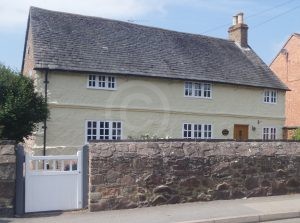
In 1766, Robert Dickenson’s house was registered for worship.[1]
In 1779, Moses Johnson’s house was registered for worship.[2]
In 1796 Simeon Bruin registered his house for worship.[3] In 1800 a chapel owned by Mrs Earl was registered by George Button. Others who signed the application included Simon Bruin, Samuel Ackroyd and William Sculthorpe.[4] This is presumably the same group that had previously met in Simon Bruin’s house. The group may have split, or they may have had two meeting places, as in 1804 a house occupied by William Sculthorpe was also registered, with Simon Brewin also signing the application.[5]
In 1817, a building on Woodgate was registered by William Disney.[6]
Samuel Ackroyd appears again in January 1818, when his house was registered for worship by Byron Richardson.[7] In December that year, Ackroyd registers his house again, without Richardson.[8] The following year, Byron Richardson registered a building on Woodgate for worship. Later in 1819 he also registered a former carpenter’s shop in Preston’s Yard, Woodgate (possibly the same building), which he occupied, but which was owned by innkeeper John Preston.[9]
In 1820, John Raven registered his house on High Street.[10]
In 1820, a chapel was registered by John Duick.[11]
General Baptists
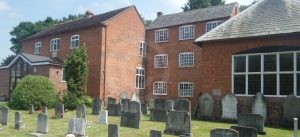
A congregation began to meet in a private house in the 1760s.
The congregation built a General Baptist chapel on what became Meeting Street in 1770.[12] The building was soon enlarged, and in 1829 it had a congregation of 400 people.[13] In 1846, the chapel was said to have had 600 sittings.[14] This may be an overstatement, although it was certainly large, as in 1851 there were said to be 162 free seats and 288 others.[15] There were morning and evening services on Sundays, with numbers attending on census Sunday in 1851 being 240 in the morning and 450 in the evening.
A further large extension to the building is dated 1897, and there is a 20th century porch.
By 1846, there was also a large Sunday School room attached to the chapel.[16] It was attended by 150 people in 1851, when it just met for morning classes.
Wesleyan Methodist
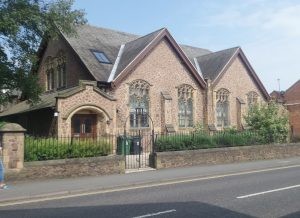
A Wesleyan Methodist chapel was built in Quorn in 1819.[17] A congregation of 200 Wesleyan Methodists met here in 1829.[18] The chapel had 200 seats, 96 of which were free. The congregation had split in about 1850, and those remaining numbered just 25 in the morning and 54 in the evening on census Sunday in 1851. The average congregations were said to have been 50 and 90 respectively, and it may be that some of their usual number were at the Primitive Methodist chapel that evening for their well-attended funeral sermon.[19] Sunday school attendance that day, 52 in the morning and 27 in the evening, was almost the complete opposite of the attendance numbers in the services.[20]
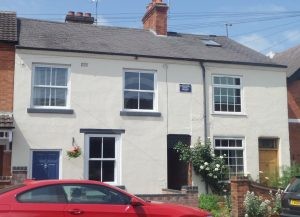
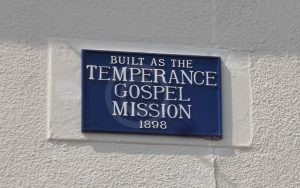
A temperance hall was built in 1898. It is now a private house.
The original chapel of 1819 was demolished and replaced by a new chapel in 1907. This has since been converted into flats.
Wesleyan Reform Methodist
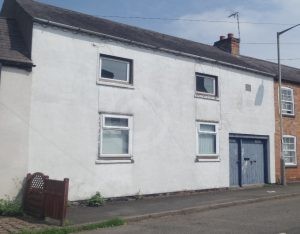
The Wesleyan congregation split in about 1850. In October 1850, a group calling itself a Wesleyan Methodist Branch Society, converted a residential house in School Lane into a chapel to accommodate 60 worshippers. In March 1851 the building was used exclusively for worship, and 40 people met there for worship in the morning, and 43 in the evening. Their preacher was Jabez Jarratt of Loughborough.[21] The chapel closed in the early 20th century.
Primitive Methodists
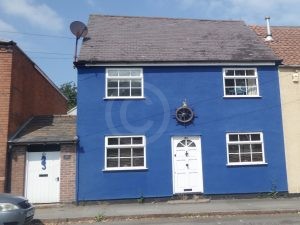
A Primitive Methodist chapel was built in 1820.[22] A congregation of 60 was meeting here in 1829.[23] In 1851, the chapel had 198 free sittings and 52 other sittings, with standing room for 20. They met for worship in the afternoon and evening, with average attendances of 40 and 60 respectively, but on Census Sunday in 1851 there were 90 people in the congregation that afternoon and 250 in the evening.[24] George Broughton, who described himself as the ‘local preacher’, ascribed the high numbers that day to ‘a revival of religion [that] has broken out and in the society assembly here’ and a funeral sermon that was preached in the evening.[25] There was a very small afternoon Sunday school, attended by just 16 people on census Sunday, 1851.[26]
Sources
[1] ROLLR, QS 44/1/2.
[2] ROLLR, QS 44/1/2.
[3] ROLLR, 1D 41/44/53
[4] ROLLR, 1D 41/44/116
[5] ROLLR, 1D 41/44/152
[6] ROLLR, 1D 41/44/327
[7] ROLLR, 1D 41/44/334
[8] ROLLR, 1D 41/44/362
[9] ROLLR, 1D 41/44/394; 1D 41/44/408
[10] ROLLR, 1D 41/44/436
[11] ROLLR, 1D 41/44/440
[12] W. White, His. Gaz. and Dir. Leics. (Sheffield, 1846), 320
[13] ROLLR, QS 95/2/1/83
[14] W. White, His. Gaz. and Dir. Leics. (Sheffield, 1846), 320
[15] TNA, HO 129/416/31
[16] W. White, His. Gaz. and Dir. Leics. (Sheffield, 1846), 320
[17] TNA, HO 129/416/34
[18] ROLLR, QS 95/2/1/83.
[19] TNA, HO 129/416/34
[20] TNA, HO 129/416/34
[21] TNA, HO 129/416/32
[22] TNA, HO 129/416/33
[23] ROLLR, QS 95/2/1/83
[24] TNA, HO 129/416/33
[25] TNA, HO 129/416/33
[26] TNA, HO 129/416/33